Daily message / devotional
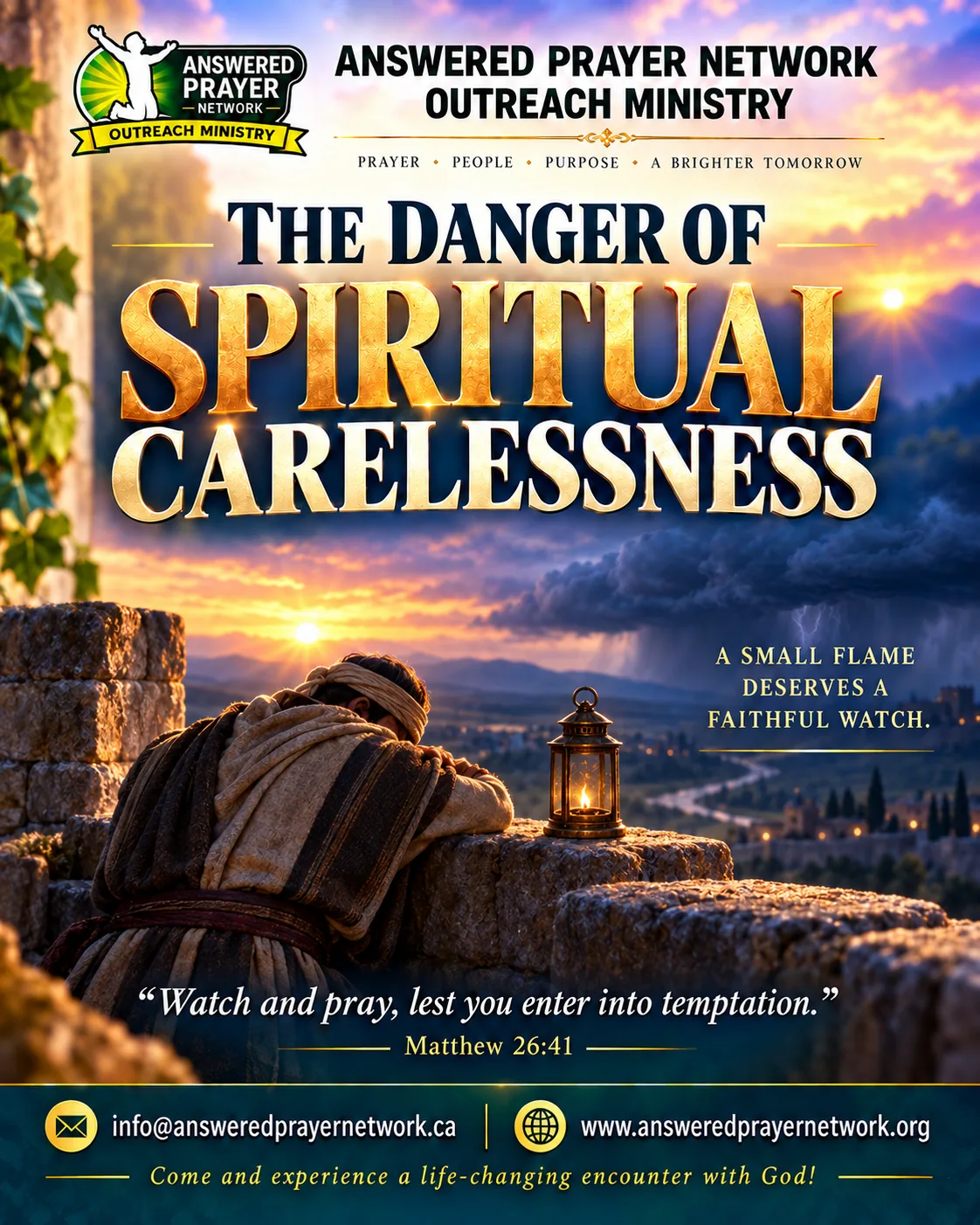
THE DANGER OF SPIRITUAL CARELESSNESS
Key Scripture
[12] Therefore let him who thinks he stands take heed lest he fall.New King James Version®, Copyright© 1982, Thomas Nelson. All rights reserved.
Daily message / devotional
Spiritual carelessness is one of the quietest yet most dangerous enemies of a believer. It rarely begins with an open rejection of God. It often begins with small compromises, neglected prayers, ignored convictions and a gradual loss of spiritual sensitivity. What appears harmless today can eventually become a doorway through which the enemy attacks a person’s faith, character, family and destiny.
A spiritually careless person may still attend church, speak Christian language and appear outwardly committed. Yet inwardly, the fire is fading, the prayer altar is weakening, and the voice of God is becoming distant. Spiritual carelessness is dangerous because it creates the illusion that everything is well while destruction is silently approaching.
When Watchfulness Is Lost
Jesus repeatedly instructed His disciples to watch and pray. He understood that prayer without watchfulness can leave a believer vulnerable, while watchfulness without prayer leaves a person without spiritual strength.
In Matthew 26:41, Jesus said:
“Watch and pray, lest you enter into temptation. The spirit indeed is willing, but the flesh is weak.”
The disciples loved Jesus, but love alone did not keep them awake. Their intentions were sincere, but their spiritual alertness was weak. While Jesus prayed in agony, they slept. When the hour of betrayal arrived, they were spiritually unprepared.
Many believers do not fall because they intended to abandon God. They fall because they stopped watching. They became careless about what entered their hearts, what influenced their minds, whom they permitted into their lives and what habits they entertained.
The enemy does not always announce his arrival. Sometimes he enters through an unguarded appetite, an uncontrolled emotion, an unhealthy relationship or a compromise that appears insignificant.
Carelessness Begins With Small Neglect
No one becomes spiritually cold in a single day. Spiritual decline is usually gradual. One missed prayer becomes several days without prayer. One ignored warning becomes a lifestyle of disobedience. One tolerated sin becomes a secret bondage. Eventually, the person who once trembled at God’s Word begins to justify what they previously resisted.
Hebrews 2:1 warns:
“Therefore we must give the more earnest heed to the things we have heard, lest we drift away.”
Drifting does not require deliberate movement. A person only needs to stop resisting the current. In the same way, spiritual decline begins when a believer stops making deliberate efforts to remain close to God.
A neglected garden does not remain empty; weeds take possession of it. Likewise, a neglected spiritual life does not remain neutral. When prayer disappears, temptation gains strength. When the Word is abandoned, deception finds room. When discernment becomes dull, the wrong voices begin to sound convincing.
The Tragedy of Samson
Samson was called, anointed and empowered by God, but he became careless with his consecration. He repeatedly played around the boundaries of his calling. He treated sacred things casually and assumed that yesterday’s anointing would continue to protect today’s disobedience.
Judges 16:20 records one of the most frightening statements in Scripture:
“But he did not know that the Lord had departed from him.”
Samson arose expecting his former strength, but the spiritual reality had changed. His hair had been cut, his consecration had been violated, and the presence that empowered him was no longer operating as before.
This is the danger of spiritual carelessness: a person may continue moving without realizing that something precious has departed. Activity can continue after intimacy has been lost. A title may remain after spiritual authority has weakened. The appearance may still be impressive while the inner altar is in ruins.
Samson’s enemies did not first destroy his strength; they discovered the secret of his consecration. The enemy is always interested in what sustains a believer’s spiritual power. He attacks prayer, purity, discipline, obedience and devotion because he knows that when the altar is weakened, the life becomes vulnerable.
The Danger of Sleeping at the Wrong Time
In Matthew 13:25, Jesus declared:
“But while men slept, his enemy came and sowed tares among the wheat and went his way.”
Sleep in this passage represents more than physical rest; it reveals the danger of spiritual negligence. The enemy sowed corruption while those responsible for the field were unaware.
There are times when spiritual sleep can be costly. When parents become careless, the enemy may attempt to influence their children. When leaders stop praying, confusion can enter the ministry. When a believer ignores discernment, destructive relationships may gain access. When families abandon their spiritual altar, division and disorder can take root.
The enemy looks for unguarded territories. He searches for prayerless homes, wounded hearts, undisciplined appetites and unattended spiritual gates. He plants seeds quietly and waits for them to grow.
This is why believers must guard their hearts, homes, marriages, children and divine assignments through prayer, wisdom and obedience.
Carelessness Weakens Spiritual Discernment
One of the first consequences of spiritual carelessness is the loss of discernment. A spiritually alert person can recognize danger even when it is attractively packaged. But when discernment becomes dull, temptation begins to look like opportunity, deception begins to sound like revelation, and distraction begins to appear like progress.
Lot saw the well-watered plains near Sodom, but he failed to discern the spiritual danger of the environment. What looked profitable eventually exposed his family to destruction. Not every open door is from God. Not every attractive relationship is divinely appointed. Not every opportunity deserves acceptance.
Spiritual carelessness judges only by appearance. Spiritual discernment asks: Will this decision strengthen or weaken my relationship with God? Will it protect or endanger my calling? Will it move me toward God’s purpose or gradually pull me away?
Proverbs 4:23 instructs us:
“Keep your heart with all diligence, for out of it spring the issues of life.”
Your heart is a gateway. Whatever continually enters it will eventually influence your decisions, words, desires and direction.
Carelessness Gives the Enemy an Advantage
Ephesians 4:27 warns believers not to “give place to the devil.” This means the enemy cannot occupy every area automatically; he looks for access. Unforgiveness can become access. Pride can become access. Secret sin can become access. Uncontrolled anger, bitterness, spiritual laziness and disobedience can all create openings.
Spiritual warfare is not only about rebuking the devil; it is also about closing the doors through which he seeks to operate.
A believer cannot continually entertain darkness and expect to walk strongly in light. We cannot feed our flesh throughout the week and expect spiritual strength to appear during a crisis. The hour of battle reveals the strength of the altar that was built before the battle began.
David defeated Goliath publicly because he had learned to trust God privately. Daniel stood fearlessly before kings because he had maintained a disciplined prayer life. Joseph overcame temptation because he valued God’s presence above temporary pleasure.
Private spiritual discipline produces public victory.
Familiarity With Sacred Things
Spiritual carelessness can also develop through excessive familiarity. A person can become so accustomed to prayer, Scripture, worship and ministry that holy things no longer carry weight in their heart.
The Word of God becomes “just another message.” Worship becomes entertainment. Prayer becomes a routine. Divine warnings are postponed. Correction is rejected. The presence of God is treated casually.
However, sacred things must never become common to us. Every opportunity to pray is a privilege. Every instruction from God deserves attention. Every conviction of the Holy Spirit is an act of mercy calling us back before destruction comes.
God’s warning is not condemnation; it is protection. When the Holy Spirit exposes an area of weakness, He is not trying to shame us. He is revealing what must be corrected so that the enemy will not exploit it.
The Cost of Losing the Spiritual Fire
Leviticus 6:13 declares:
“A fire shall always be burning on the altar; it shall never go out.”
The fire of prayer, holiness, worship and devotion must be deliberately maintained. Fire does not preserve itself. It requires fuel. Yesterday’s prayer cannot replace today’s fellowship. Yesterday’s revelation cannot sustain a permanently neglected altar.
When spiritual fire goes out, passion disappears. Conviction weakens. Compromise becomes easier. The world becomes more attractive, and the things of God begin to feel burdensome.
A believer must recognize the warning signs:
- Prayer has become difficult and irregular.
- Scripture no longer receives serious attention.
- Sin is explained rather than confronted.
- Correction produces anger instead of repentance.
- Entertainment has replaced spiritual discipline.
- The opinions of people matter more than the approval of God.
- Spiritual responsibilities are continually postponed.
- The heart has become insensitive to the Holy Spirit.
These signs should not lead to despair; they should lead to immediate repentance and restoration.
Returning to Spiritual Alertness
The cure for spiritual carelessness begins with honest self-examination. Lamentations 3:40 says:
“Let us search out and examine our ways, and turn back to the Lord.”
We must ask God to reveal every neglected area, hidden compromise and unguarded door. Genuine repentance is more than feeling sorry; it is turning away from what has weakened our relationship with God.
The spiritual altar must be rebuilt through consistent prayer, meditation on God’s Word, obedience, fasting, worship and godly accountability. Anything that repeatedly draws the heart away from God must be confronted.
Believers must also learn to respond quickly to the Holy Spirit. Delayed obedience is dangerous because every ignored conviction makes the heart less sensitive. What troubles the conscience today may become normal tomorrow if it is continually resisted.
Do not wait until temptation becomes captivity. Do not wait until a crack becomes a collapse. Do not wait until the fire has completely disappeared. Return to God while the warning is still sounding.
Conclusion
Spiritual carelessness is dangerous because destiny can be lost through what appears to be a small act of negligence. Esau treated his birthright carelessly and exchanged it for temporary satisfaction. Samson treated his consecration carelessly and lost his strength. David became careless when kings went to battle, and temptation found him in a place of idleness.
Your calling is too precious to handle carelessly. Your spiritual life is too valuable to neglect. Your family, future and divine assignment require vigilance.
Therefore, guard your heart. Protect your prayer altar. Honour your consecration. Examine every relationship and influence. Remain sensitive to the Holy Spirit, and never become so comfortable that you stop watching.
The enemy may be persistent, but a watchful believer is not easily captured. Stay awake. Stay prayerful. Stay obedient. Keep the fire burning, because what God has placed upon your life is too valuable to lose through spiritual carelessness.